Four Dependencies: Where Europe Relies on Others for Its Digital Foundations
2026-07-14 • Source: KR & Associates
Foundation models, identity, hyperscale cloud and payments: four layers where the EU depends on providers it does not control, and where European responses are taking shape. The first article in a four-part series with KR & Associates.
*This article is part of a four-part series on European digital sovereignty, published in partnership with [KR & Associates](https://kevinryan.io).*
When the United States signalled that it might switch off Starlink over Ukraine, the thinness of Europe's own provision became plain. As one European satellite executive observed, there is "no substitute for Starlink", and the effort to fund a home-grown alternative through groups such as Eutelsat and SES showed how far Europe had to travel. That case is one instance of a wider pattern. Digital sovereignty is the capacity of the European Union to control the data, software, hardware and infrastructure on which its economy and public administration depend, and to set its own rules over them. Four dependencies show where that control is thin, and each is a decision a technical manager will recognise from their own procurement.
## Foundation models
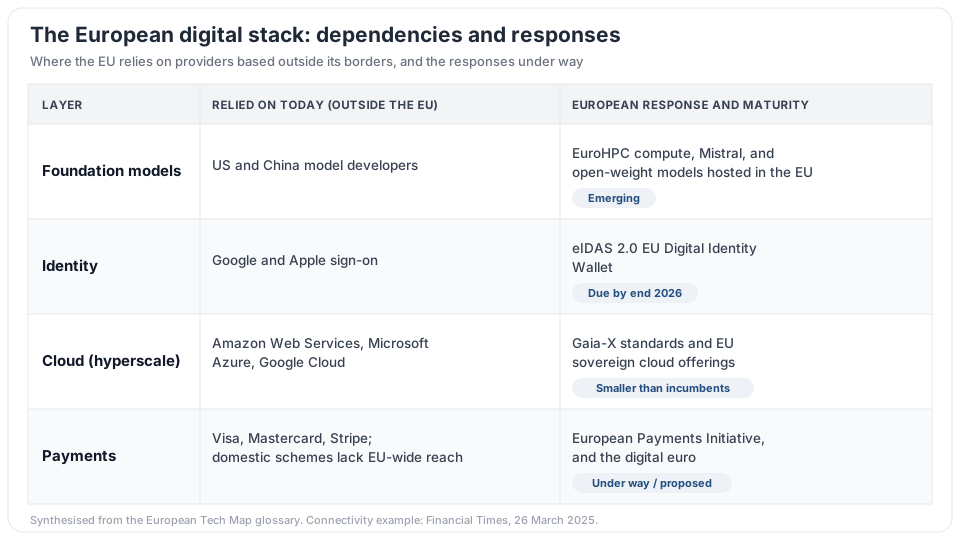
The first is foundation models. The most capable models are built by firms in the United States and in China, so European teams adapt systems they do not own or control. The exposure that creates was clear in June 2026, when a United States directive issued on national security grounds required Anthropic to limit access for all foreign nationals, and the net effect was that its most powerful models, Mythos 5 and Fable 5, were withdrawn from every user, including in the United States. The export controls were lifted on 30 June and Fable 5 was restored globally on 1 July. A model relied on from outside the United States can be restricted by a decision taken in Washington. The responses are taking shape: shared public compute through EuroHPC, investment in European developers such as Mistral, and open-weight models that can be hosted inside the EU. The right model for a given team depends on its performance needs and its residency obligations together, and no single option suits every organisation.
## Identity
The second is identity. Federated login, the means by which a person reaches many services with one set of credentials, is dominated by Google and Apple sign-on, and providers established in the EU are scarce. The European answer is the European Digital Identity Framework under eIDAS 2.0, which requires every member state to offer an interoperable EU Digital Identity Wallet by the end of 2026. For a manager, the wallet is worth watching as a route to authenticating customers and staff without routing that step through a United States provider.
## Cloud at hyperscale
The third is cloud at very large scale. Compute, storage and global reach with central billing are supplied by Amazon Web Services, Microsoft Azure and Google Cloud, all headquartered in the United States, and the EU has no domestic provider of comparable size. Gaia-X aims to define standards for sovereign cloud, and sovereign offerings built on infrastructure within the EU are emerging, though they remain smaller than the incumbents.
## Payments
The fourth is payments. The international card schemes Visa and Mastercard are headquartered outside the EU, the providers that many European merchants rely on, such as Stripe, are United States companies, and the domestic schemes that exist, such as Cartes Bancaires and Girocard, lack pan-European reach. The European Payments Initiative and the prospective digital euro are the responses under way.
## What follows
Two conclusions follow. On capability, the practical question is which of the four layers a team depends on today, and where a [European option has become viable](/alternatives-to) for new work. On compliance, the supplier chosen for each layer decides where data sits and which law governs it, so the procurement decision and the compliance decision are the same decision. Where the right answer turns on an organisation's own systems and its appetite for risk, there is no off-the-shelf solution. European Tech Map, working with a boutique consultancy such as [KR & Associates](https://kevinryan.io), can help a team weigh the options and reach one suited to its circumstances.
*By Peter Houghton, Kevin Ryan & Andy Wijman, KR & Associates*
*Sources: Peggy Hollinger, Euan Healy and Barney Jopson, Financial Times, 26 March 2025; George Hammond and Joe Miller, Financial Times, 13 June 2026.*
Tags: policy, procurement