How Did We Get Here? The Long Roots of Europe's Digital Dependence
2026-08-04 • Source: KR & Associates
Why has Europe found digital sovereignty so hard to reach? Four threads tell most of the story: the missing hyperscalers, the semiconductor supply chain, a thin record in defence research, and the laws that made interoperability hard. The final article in a four-part series with KR & Associates.
*This article is part of a four-part series on European digital sovereignty, published in partnership with [KR & Associates](https://kevinryan.io).*
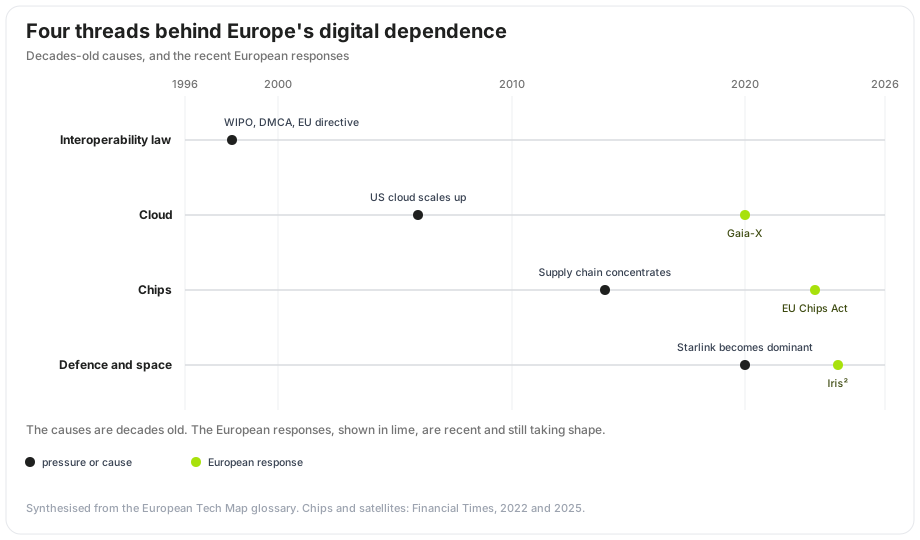
Why has Europe found digital sovereignty so hard to reach? The dependencies are familiar, on foundation models, cloud, identity and payments. The reasons behind them run deep, and they help explain why a home-grown alternative tends to cost more and arrive later. Four threads, pulled together, tell most of the story: the missing hyperscalers, the semiconductor supply chain, a thin record in defence research, and the laws that made interoperability hard.
## The missing hyperscalers
Start with the missing hyperscalers. The American cloud providers reached enormous scale early, and once they had, capital and network effects made them very hard to catch. A European challenger would have needed to match them across a single market that was still split by language, currency and national rules, which slowed everything down. The lesson is about pooling: shared demand and common standards, which is what Gaia-X is trying to build, give a domestic effort a fighting chance.
## The chips
Then there are the chips. The supply chain for advanced semiconductors sits with a handful of firms in Taiwan, South Korea and the United States, and that is where the leading edge is made. Europe is far from absent here. ASML in the Netherlands holds a monopoly on the extreme ultraviolet machines that print the smallest chips, Carl Zeiss supplies their optics, Trumpf supplies their lasers, and IMEC near Brussels is a world-class research hub. The gaps are in chip design, where no European firm sits among the world's ten largest, and in leading-edge fabrication. The EU Chips Act is the response, with an aim to lift the bloc's share of global production towards a fifth by 2030, though the sums are large and the timelines long.
## Defence
The third thread is defence. Europe has little recent history of the large defence research spending that, in the United States, seeded so much of modern computing. The cost of that gap showed in 2025, when the prospect of losing Starlink over Ukraine sent the continent scrambling for an alternative. Even with capable operators in Eutelsat and SES, Europe has nothing at Starlink's cost and scale, and the answer on the table, the ten billion euro Iris² programme and the pooling of secure capacity through GovSatCom, is expensive and slow to stand up. As the chief executive of SES put it, it is "impossible to replace Starlink in a day". The lesson is patient public research with a clear path to market.
## The quietest thread
The fourth thread is the quietest, and it still matters. Laws that began with the WIPO Copyright Treaty of 1996, and arrived as the Digital Millennium Copyright Act in the United States and Article 6 of the Information Society Directive in the EU, made it legally risky to work around the locks on a product, and so to interoperate with it or repair it independently. Critics such as Cory Doctorow argue that the effect is to entrench the firms already in place. The lesson is straightforward: interoperability and a right to repair are levers Europe can pull.
## Pulling the threads together
Pull the threads together and the picture is of dependencies built up over decades, which is why none of them will be undone quickly. For an organisation the practical question is one of degree: how much sovereignty to buy, for which workloads, and at what price. Working that out for your organisation is exactly where European Tech Map, together with a consultancy such as [KR & Associates](https://kevinryan.io), is happy to help.
*By Peter Houghton, Kevin Ryan & Andy Wijman, KR & Associates*
*Sources: Lauly Li, Financial Times, 13 December 2022; Peggy Hollinger, Euan Healy and Barney Jopson, Financial Times, 26 March 2025.*
Tags: policy, procurement